
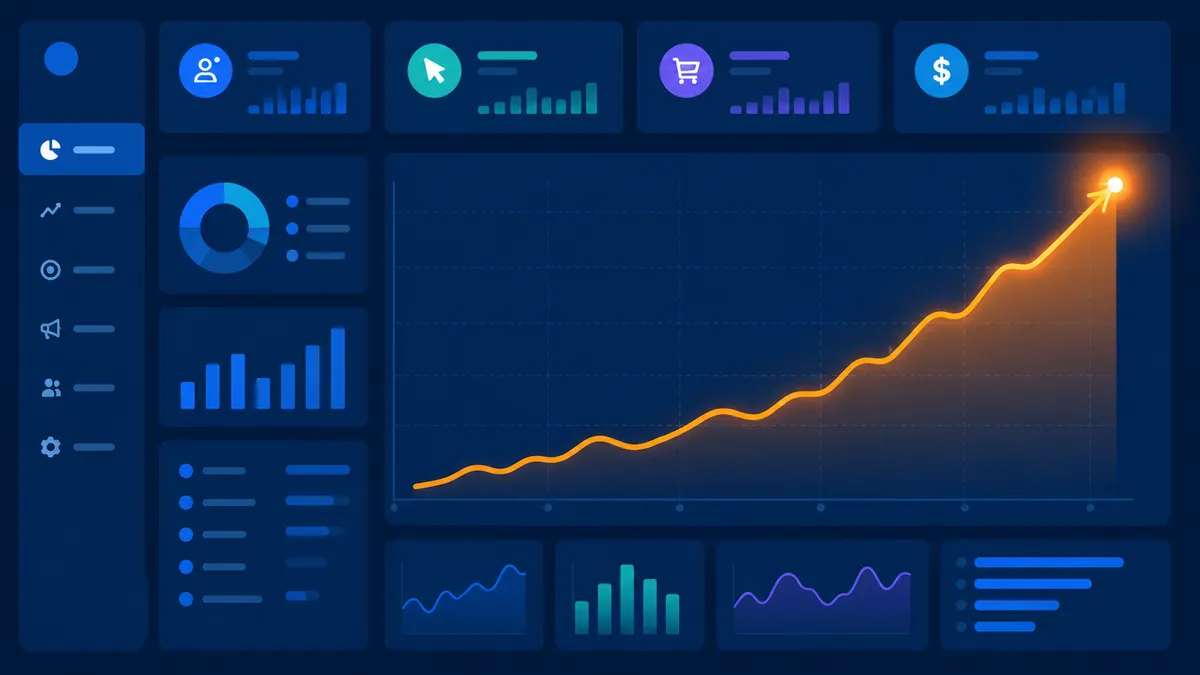
Let's clear something up right away: performance marketing isn't about "running some ads." It's about building a money-printing machine where every rupee you put in returns more rupees out. Predictably. Measurably. Without the fluff.
Most businesses run ads. Very few do performance marketing. The difference? One hopes. The other knows.
What makes performance marketing different?
Traditional advertising is built on hope. You put up a billboard, a TV spot, or even a social media campaign, and you hope it works. You measure it in vague terms like "brand awareness" or "engagement." Performance marketing flips that entirely. You only pay for real, measurable actions — clicks that turn into leads, leads that turn into sales.
It's direct, trackable, and brutally honest. If an ad doesn't convert, it dies. If an ad works, it gets more fuel. No mercy.
The three pillars of performance marketing are:
Tracking and attribution. If you can't measure it, you can't improve it. Performance marketing lives and dies by data. Every click, every purchase, every lead — tracked back to the exact ad, keyword, or audience that caused it.
Optimization. Once you know what's working, you do more of it. But here's the trick: real optimization isn't just about increasing budget. It's about refining targeting, creative, landing pages, and bidding strategies so that every rupee works harder.
Testing. The best performance marketers are obsessive testers. Headlines, images, calls-to-action, audiences — everything gets tested. The winners stay. The losers get cut. It's a continuous cycle of improvement.
What "tracking and attribution" looks like in practice
This is the part that sounds abstract until you see it laid out. Every campaign needs a clear chain: an ad, a click, a landing page, a form fill or purchase, and a way to tie that final action back to the exact ad that caused it. Without that chain, you're guessing which of five campaigns actually produced your ten new customers this month — and guessing is exactly what performance marketing exists to replace.
In practice this means conversion tracking set up correctly before a single rupee is spent, not bolted on afterward to explain results nobody can otherwise account for. It also means agreeing up front on what actually counts as a conversion for your business — a form fill, a call, a completed purchase, a booked consultation — because optimizing toward the wrong action produces a campaign that looks successful and isn't.
The channels compared — why the same ad doesn't work everywhere
Most businesses get burned running one creative across every platform and calling it efficient. The reason it backfires is intent. Google Search meets someone who already typed what they want — the job of the ad is to be the obvious, credible answer to a question they're actively asking. Meta and Instagram interrupt someone mid-scroll who wasn't looking for you at all — the job there is to earn three seconds of attention before they keep scrolling, which favours a completely different kind of creative. YouTube sits somewhere between the two: attention is semi-captive, but patience is short. Treating these as the same problem with the same ad is one of the most common reasons a budget underperforms even when the product and the offer are both genuinely good.
Why so many businesses get it wrong
Most businesses fall into the trap of "set and forget." They launch a campaign, check it once a week, and wonder why results aren't growing. Performance marketing needs constant attention and a mindset shift — from "how much did we spend?" to "how much did we get back?"
Another mistake? Loving your own creativity. Your favorite ad might be the one that performs the worst. Performance marketing doesn't care about feelings. It cares about conversions.
What good targeting actually means
"Targeting the right audience" gets thrown around as a vague virtue. Concretely, it means narrowing spend toward the people most likely to convert, based on evidence rather than assumption — past customer patterns, on-platform behavioural signals, lookalike audiences built from real converters, geographic and demographic filters that match who genuinely buys, not who you imagine buys. Broad targeting isn't inherently wrong at the awareness stage, but treating every stage of the funnel with the same broad audience is one of the fastest ways to burn a budget without knowing why.
What a performance marketing report should actually show you
A report that only shows impressions, reach and clicks is a vanity report — those numbers can look great while the business makes no money. A report worth reading ties spend all the way through to the outcome that matters to you: cost per lead, cost per acquisition, and ideally return on ad spend, broken down by campaign and audience so you can see exactly which combination is earning its keep and which is being carried by the others. If a report can't answer "which rupee spent made us money," it isn't a performance marketing report yet.
Start small, scale smart.
You don't need a massive budget to start. You need a clear goal, good tracking, and a willingness to kill what doesn't work. When you find a winner, you pour fuel on it — slowly, carefully, watching the data all the way.
A reasonable way to think about scaling: prove a campaign works at a small, controlled spend first, resist the urge to multiply the budget overnight once it does, and increase it in steps small enough that you can still tell whether performance holds or degrades at the new volume. Audiences and ad platforms both have limits to how fast they can absorb more spend before efficiency drops.
What actually gets tested, concretely
"Testing" as a word gets used loosely enough to mean nothing. In a real performance marketing engine, the elements under test typically include: the headline and hook in the first line of the ad; the creative format (a static image versus a short video versus a carousel behaves very differently even for the same product); the specific offer or call to action ("book a call" performs differently from "get a free audit" even when both lead to the same next step); the landing page itself, since an ad can do everything right and still lose the sale on a page that loads slowly or buries the actual offer; and the audience definition, tested as rigorously as the creative rather than set once and left alone. Nothing on this list gets decided by opinion in the room — it gets decided by which version actually converts more, at an acceptable cost, over a large enough sample to trust the result.
How this connects to brand and to being findable at all
Performance marketing amplifies whatever it's pointed at — including a brand that doesn't yet know what it stands for, or a business an AI assistant can't yet confidently describe. An ad campaign can absolutely drive clicks to a page that then fails to convert because the brand behind it reads as generic, or fails to build lasting recall because nothing about the experience was distinctive enough to remember. That's the practical argument for treating performance marketing as one weapon among five rather than the only one: it multiplies whatever foundation already exists, for better or worse.
Quick FAQ
How much budget do I need to start?
There's no universal minimum — the right starting number depends on your average order value and how many conversions you need to reach statistical confidence, which is a conversation worth having before setting a figure, not after.
How soon will I see results?
Early data (what's working versus what isn't) usually emerges within the first few weeks; meaningful, stable optimization compounds over a longer, ongoing run — performance marketing is closer to a discipline than a one-time campaign.
What if my industry can't track sales directly (e.g. a service business with offline closing)?
You track the closest measurable proxy — a qualified call, a booked consultation, a form fill — and connect it to actual closed business manually often enough to keep the attribution honest.
The honest downside worth knowing before you start
Performance marketing's biggest strength — brutal, immediate honesty — is also its biggest emotional cost. Campaigns that don't work get killed quickly and visibly, on a dashboard everyone can see, which is a harder environment for a team used to advertising that never quite gets measured closely enough to be proven wrong. Going in expecting some tests to fail, and treating that as the system working rather than as a setback, is part of what makes performance marketing sustainable rather than demoralizing.
Performance marketing is the closest thing to a money printer when done right. It's not magic; it's science. See exactly how we build and run these engines. And we've got the lab.
YOUR MOVE
Want to know if your current ads are actually performing? Ask us for a free ad account audit. Or call and say "money printer."
Your move
Want to know if your current ads are actually performing? Ask us for a free ad account audit. Or call and say "money printer."